Thursday, June 2, 2011

Nico by Micha Namenwirth 4

Kitty-kat

Well, bye! Nico

I climb to our bench high above the village, musing a bit there. These scrambling expeditions are getting to be too much for me. A while ago I went to see a doctor to complain about pain in the region of my heart. After examining me, the doctor said that it wasn’t too bad and prescribed pills I should take when I didn’t feel well. I’m taking one now.

*****

Why had that fountain pen emptied so quickly? When it happened again, I went secretly to Uncle Jan’s study. There was an inkstand on his desk. The pen was quickly filled, but I was clumsy and spilled some ink. Instead of explaining what had happened, so that the mess could be cleared up, I remained silent and said nothing at all.
Of course Uncle Jan soon discovered the ink spot on his desk. He was angry and gave me a few sharp blows. I cried, although deep in my heart I had to admit that he was right. And now, many years later, it’s striking that I kept quiet about all this in my letters to my parents.

*****

Where is Nico? Why hasn’t he shown up yet?
I look about me, enjoying the view. How wonderful to be here!
My thoughts go back to the time when Nico suddenly appeared, sitting next to me. Wasn’t he coming back? Hadn’t we agreed to talk about the war?
I was about to consider what I would tell him, when he suddenly appeared.
‘Wonderful you’ve come,’ I said.
Nico was in high spirits. He was still wearing his warm clothes: blue shorts, black-checkered shirt, red tie and dark-blue sweater with long sleeves ...
He appeared a little vain, didn’t he?
‘Shall I talk about the war?’
Yes, that would be fine.
I cleared my throat, ‘hmm, hmmm,’ reflected for a moment, and then began:
‘There always have been wars.’
‘Why?’ Nico inquired.
‘Possibly out of boredom, greed, revenge, anger, lust for power … People are capable of everything, both the best and the worst. They build splendid cities, create wonderful works of art, to, in the end, smash them all to pieces.’
‘Kids do the same,’ said Nico, ‘on the beach.’
‘That’s true,’ I replied. ‘Kids do the same on the beach, but there it doesn’t have quite the same impact.’
‘Yes, that’s true,’ Nico sighed.
‘Every war involves a whole lot of sadness,’ I continued.
Nico and I stared into one another’s eyes. We knew what we were talking about.
‘And why the Germans?’
‘Well yes,’ said I, ‘why the Germans? Germany is a beautiful country and its inhabitants are industrious and disciplined. It’s a civilized country, and yet … As England and France
were powerful, parceling out large chunks of the world among themselves, Germany remained for an extended period of time a collection of tiny countries, hardly playing a role in world politics. After Germany had become a single powerful nation, however, it wished to participate in international affairs. It was envious, wishing to enlarge its power. Thus the First World War broke out, a terrible war, costing the lives of millions of people.
In the end, Germany and her partners lost that war. Since there had been so many victims and since the damage done was so considerable, the Allied Forces decided to punish the Germans for all the misery that war had caused. As a consequence there was great poverty and bitterness in the land, and a climate was created that allowed sinister characters, such as Hitler, Himmler, Goebbels and Göring, to grab power. They were cunning and cruel, engaging the German people in a disastrous adventure - the Second Warld War. Some Germans opposed dictatorship, hate among peoples and a senseless war. Others supported the Nazis, acclaiming them. The majority endured submissively.’
‘Are Germans evil people?’ Nico enquired.
I hesitated, knowing full well how difficult it is to forgive one’s enemies in the middle of a war. ‘What has happened,’ I said, ‘is unforgivable. Many Germans were cowardly, failed to reflect and let events overtake them. But asserting that Germans are more evil than other nations, no, I don’t believe that. Many Dutch citizens weren’t particularly heroic either. Many collaborated with the enemy, benefitting from the opportunity. Others were passive, accepting the new reality, going along with the others. It shouldn’t have been that way, but unfortunately, that was the way it was.’
‘Germany didn’t have a democratic tradition,’ I proceeded. ‘People had been taught to obey blindly. Obedience was a quality which was highly valued. So most were obedient, even when what was being asked of them was outrageous.’
‘But why did they have to attack the Netherlands?’
I admitted that invading a small country was unfair and mean. ‘It was part of a political strategy,’ I explained, ‘to enlarge power - more land, people, and money. However, greed usually turns against the conquerer. He swallows more than he can digest. Eventually all wars come to an end.’

I observed Nico. He looked dejected. The time had arrived for another subject. ‘How is school coming along?’
‘Alright,’ he replied, but he clearly didn’t feel like conversing any further.
Then I had a luminous idea. ‘Come with me to the main street, down in the village. There is a sandwich shop that sells ice cream.’
Nico agreed that this was a good idea.

We therefore descended the trail together, slowly, because of my heart.
Having arrived below, we ordered an ice cream cone with three scoops.
Nico selected strawberry-, raspberry-, and vanilla-ice cream.
He began to lick like a madman, for it had been so long ago since he had tasted such delicious ice cream.
Between one lick and the next, he thanked me.


Then I realized that I should introduce Nico to my acquaintances in the café. ‘This is Nico,’ I said, but those present looked at me as though I had gone out of my mind.
They hadn’t seen Nico at all. Meanwhile he had disappeared.


Amsterdam


In the summer of 1940 we moved to Amsterdam to a top floor apartment in the ‘Rivierenbuurt’ (a neighborhood named after rivers). It was a busy street, but close by there was major construction going on that provided a perfect location for playing. Still I had trouble getting used to the big city.
Amsterdam was very different from Rotterdam. The Maas Street where we now lived felt different from the Van Beuningen Street in Blijdorp. Amsterdam was a whole lot busier, fuller, darker, more nervous.
Especially striking was the large Jewish population. Sometimes we visited the ghetto on the other side of the Amstel River, to buy kosher pickles and other Jewish delicacies. That section of the city was poor and run-down. It resembled the Antwerp of bonpapa and bonmama. One saw people walking about in old-fashioned clothing, with beards and ‘pijes’ (sideburns), ‘talles’(prayer shawls) under their coats, hats or yammulkas on their heads (for religious Jewish men keep their heads covered at all times). Speaking a strange language, they went about their business. The ghetto struck me as a lively place.
I knew that I was somehow connected to these people, that a shared past tied us together. And yet I was so different. Or was I?

I can remember quite a few details - the ‘Grachtengordel’ (Canal Ring), Rembrandt Square where Uncle Paul owned a building, Amstel Street and ‘Magere Brug’ (the Lean Bridge), the river, ‘Paleis op de Dam’ (the Palace on the Dam Square). The image of the movie house ‘De Uitkijk’, on the Prinsengracht is also printed on my brain, though I have no idea whether I visited the theater at that time. My memory isn’t entirely reliable, I must admit. Since we returned to Amsterdam after the war, it is entirely possible that images, sounds and smells I believe I can recall from the war years, in fact go back to post-war experiences.

In September 1940 I went to school for the first time. In honor of this important event mother had bought new clothes which she piled high on a chair, ready to be worn. I was tossing about in my bed, at once proud to be a real pupil and scared for the unknown.
Accompanied by my big brother I bicycled to school. Since we were no longer allowed to attend a ‘regular’ school, we joined a Jewish school. It was located in ‘de Pijp’, then a lower class quarter between our neighborhood and the old city.
In Blijdorp John had been a pupil of a Dalton School, a modern institution housed in a brand-new building displaying a lot of glass, light and color. The Jewish school had an old-fashioned feel: an old and somber building, antique furniture, slate pencils and slates, ‘Aap, Noot, Mies’ and ‘Ot and Sien’ (historical didactic tools).
It took getting used to. I had never been in the company of so many Jewish people. Everyone was Jewish: all the pupils, all the teachers, everybody. The mood at school was excited, nervous, alienating. It was as though we were constantly waiting for something to happen. And though the school radiated unease, I enjoyed attending … up to a point.


But the Amsterdam interlude wasn’t entirely enjoyable. Although we weren’t directly threatened yet, the imminent danger was palpable. My parents and brother reassured me. I lived at home, nevertheless realizing that an unpleasant future awaited us. People whispered about concentration camps, looking grim, not all the time of course, but frequently.
Jews were encouraged to give themselves up voluntarily. Supposedly they would be taken to labor camps where they would lead a comfortable life in a kind of summer camp. Similar to Zus en Pien on the Veluwe? Dad had finally learned his lesson, convinced that the Nazis could not be trusted. I still remember discussions at home between my parents and a young couple who were about to answer the call. Mom and dad failed to convince their young friends. They voluntarily courted disaster, departing happily, rucksacks on their backs. Of course we never saw them again.

The German occupiers were anxious to avert panic, so they pretended to mean well. The persecution of the Jews wasn’t inaugurated all of a sudden, but introduced step by step. I recall the posters in fearful letters, again and again announcing new restrictions: Jews were no longer permitted to do this, to do that. Slowly but surely the noose was tightened.
By then we were ordered to wear the Star of David. This was a yellow and black piece of cloth that Jews were obliged to pin to their chests. The intent was to isolate us, to clip our wings and to break our will.
Usually we refused to wear the star. Yet I recall once when John and I were visiting our grandparents in The Hague, traveled by train and, that day, we had attached the thing to our lapels. We meant this as an act of rebellion: we are Jews and we are proud of it. It clearly was a silly thing to do. We never did it again.

It is said that grandfather made a fortune several times in his life, only to lose it again each time. The family constantly moved from Rotterdam to The Hague, from The Hague to Scheveningen and then back to The Hague again, each residence a reflection of the relative prosperity of the moment. As a consequence mother developed a life-long passion for The Hague.
At the beginning of the war granddad must have been reasonably wealthy, for my grandparents lived in a stately house, apparently not affected by events. Their front door was opened by a butler in a red and white striped coat. The billiard room at the entrance to the hallway was filled with cigar smoke: grandfather was playing billiards by himself. There one day a wasp stung me so badly in the hollow of my knee, that I had to be taken to a physician.

For a short while my Aunt Bap stayed with us in Amsterdam. I was happy that she had come, for I loved her dearly. She and I were ill at the same time, lying in bed in adjacent rooms. I was playing with a cotton monkey. The door connecting our rooms was open and my aunt was trying to teach me to count in French: un, deux, trois … Whether I was too ill or preferred playing with my monkey, I failed repeatedly in reciting the long sequence from one to twenty without error. It was decided then and there that I was stupid, incapable of learning anything. There was no end to the teasing and that didn’t sit well with me.


We owned a tom-cat who loved sitting on the window sill, watching the bustle down in the street below. One day he tumbled down. Since I adored my pussy cat, I ran downstairs after him, convinced I would find a dead cat. But he was alive and kicking, and acted as if nothing had happened, falling down three storeys, miowed lustily and rubbed himself against my leg. Very carefully I carried him upstairs, asking myself if we, too, would like the tom-cat land safely on our feet.

Saturday, May 28, 2011

Nico by Micha Namenwirth 3


What you see here is a fighting knight

*****

I am sitting at my desk, going over the letters again. Those first letters, dealing with the Marquess of Carabas, were written after Nico had lived for many months with the family Kramer in Leeuwarden. Between Christmas 1942 and May 1943 quite a few letters must have been written, but there is no trace of them. Probably mother was afraid to hold on to them. After all, it was a dangerous time. Had my parents been arrested, those letters might have endangered my life too.

I don’t recall much about the trip to Leeuwarden, other than that I was by myself. It was freezing so that, very soon after my arrival, I went skating on a pond close to my new home. It was lonely, for I didn’t know a soul.

I clearly remember the first day of school: unknown children and a cheerless old building in an unfamiliar city. But the teacher had drawn, in colored chalk, a splendid Santa Claus and Black Peter on the blackboard (Sinterklaas and Zwarte Piet are endearing characters from Dutch folklore, celebrated on December 5th). It must have been November or December 1942. I was eight years old and a third grader.

Why did I produce such a weird sentence? ‘The people here inquire why you don’t ask Mrs. Kramer if your mother could come and see you for a short while.’

Why didn’t Nico simply write: ‘Mommy, I miss you. Why don’t you visit me here?’

Was he putting a brave face on it? Was he hiding his loneliness, how much he longed to be with his mother?

*****

I put the letters away and decided to go for a stroll, from our alley to the main street, and from there directly into the cliffs. After ascending for a quarter of an hour, one comes to a level stretch with a bench. From there one has a splendid view of our village, the ocean and the large island across the water, boasting the enormous volcano El Teide which dominates the entire region. Snow crowns its summit.

Clambering up the rocks proved hard. I was breathing heavily, feeling some discomfort around the heart.

Finally I reached my goal! Contented, I sat down on my bench. Nico’s image forced itself upon me, so long ago, and so far from home. He must have been putting a brave face on it, for sure, not about to admit how he really felt.

The climb, and the manifold memories, had made me sleepy. I closed my eyes, visualizing Nico in my mind. How small he was, wearing long stockings and short pants. He had an ugly pair of glasses on his nose, but otherwise made a pleasant impression.

I opened my eyes and could scarcely believe what I was seeing ... Nico was sitting next to me on the bench, looking around him in utter surprise at the palm- and orange trees, cacti … and me.

Then he asked: ‘Do you speak Dutch?’

‘Absolutely.’

‘That’s lucky. My name is Nico.’

‘I am Micha,’ I replied politely.

Nico blushed and turned ashen, not knowing what to make of it. He recalled his mother’s admonition: ‘You have to forget everything about your past, that you were called Micha once, that you used to be a Jewish boy.

I reassured him: ‘There’s no reason to worry. I won’t betray you. You and I are one and the same person.’

Frowning, Nico looked at me. ‘But that’s impossible. How can it be?’

I didn’t know myself what to think of it. ‘You are Nico, I am Micha. Let’s leave it at that.’

But Nico didn’t allow himself to be put off. He hesitated and then continued: ‘So you are what I will become and I am what you were?’

I eyed him admiringly. Then a grin appeared on his face. A heavy weight seemed to drop off his shoulders. ‘So I will not be rounded up.’

‘Right you are. You, your brother, your father and your mother, all of you will survive the war.’

Nico stared into space. Then he asked: ‘Did many people die?’

‘Terribly many,’ I replied.

‘Soldiers?’ he wanted to know.

‘Indeed, soldiers, but civilians as well.’

‘Jewish people?’ he asked so softly that I could hardly understand him, scared apparently that someone else would overhear.

‘Quite a few.’

‘How ... and why?’ he inquired.

‘That’s a long story,’ I said. ‘Next time you visit me, I’ll tell you about it.’

Silently we sat on our bench.

We observed one another furtively, each making sure that the other hadn’t left.

How was it possible?

After a while I closed my eyes. When I reopened them, he was gone.


War

Recalling the pre-war period, I see a motley procession of individuals pass in review - relatives, friends, acquaintances, including quite a few children. Many of those I knew back then have disappeared - emigrated or picked up. Few ever returned.

Mother had two brothers - Uncle Jacques and Uncle Max.

Jacques was the oldest. Having inherited grandmother’s nervousness, he was excitable and unpredictable; a born actor, talker and salesman. Years later I accompanied him on a business trip. Every shopkeeper we visited was afraid of him, scared of being persuaded to buy things they didn’t really need. One merchant in a quiet village street somewhere in the heart of Holland, hastily closed his front door and curtains the moment he noticed Uncle Jacques, simply to avoid temptation.

Jacques was married to Stien. She was a darling, but my parents maintained a certain distance - often though not always - probably because she was a practicing Christian. Ridiculous! They had three children who were indeed raised as Christians. Sim, the oldest, was named for granddaddy Monasch. My name was Simon too, actually Simon Michael, but since there was a Simon in the extended family already, they called me ‘Micha’. And then there were cousins Corrie and Eddie.

With the exception of certain inexplicable periods of rapprochement, our relationship with Uncle Jacques’ family always remained on the cool side. I suspect that there had been arguments in the family business, differences of approach, conflicting personalities. And indeed, Jacques and daddy were rather diferent.

Father was reserved and rational, his brother-in-law highly emotional, spontaneous, and probably not always as sensible as he should be. I always liked Jacques and his kin, regretting that we maintained such limited contacts. All were extremely affectionate when we did get together. Later, I tried to make overtures, but it wasn’t easy to sustain a closer relationship against my parents’ wishes. But was it against the wishes of both my parents? In truth, mother’s attitude was ambivalent. She maintained a certain solidarity with dad, but missed the regular contact with her own relatives. This was true, in a sense, for Uncle Max’s family as well.

Max was quite a bit younger and less outspoken than Jacques; he got along a little better with dad. Immediately prior to the ourbreak of the war, he married Minnie. They had a single child, Cousin Lon. Uncle Max was a romantic figure, at least in my eyes. He imagined himself to be a great athlete, a soccer player supreme, a runner, a long-distance swimmer, God knows what, telling us colorful stories about sports achievements which, in all likelihood, reflected little more than wishful thinking. He had a pleasant singing voice, and played the violin, in everything displaying a certain bravura.

Like grandfather and Uncle Jacques, he radiated cordiality and warmth … similar to mother for that matter. This was lacking in my father and the Namenwirth clan in general. They were more introverted, reflective, reserved. At home it was often said: ‘He is a real Namenwirth,’ or, ‘She is a real Monasch.’

Micha was supposed to be a real Namenwirth. I have always considered that statement to be an injustice. In my opinion I was neither one nor the other. And why not? Why couldn’t I be both a Namenwirth and a Monasch? But not everyone in our family agreed, and probably I am more of a real Namenwirth than a real Monasch. Too bad really, for I admired my grandfather Simon Monasch and would have liked to be even more like him than I am.

We frequently had visitors. I remember excited conversations, laughter, tasty food and drink. There was the Slijper family. He was a lawyer. Until recently she had been a judge in Germany and, like so many others, had to flee the Nazis. We saw a lot of Bap and Norbert Loeser. He had come over from Germany as well. Bap was a cousin of my mother’s and probably her closest friend. Very special was Uncle Paul. He wasn’t a real uncle, more a legacy uncle. Paul and Lena Colin were a bit older than my parents. His real name was ‘Witjas’ and he came originally from the city of Antwerp. Having emigrated to Amsterdam as a diamond polisher, he had become a professional cabaret artist, member for many years of the, at the time, famous cabaret company of Jean-Louis Pisuisse. Paul sang entertaining songs, accompanying himself on the guitar. During a very long period, he remained a key figure in our family life.

There was lively conversation during meals, primarily by mother. When John and I weren’t supposed to understand what was being said, my parents switched to German or French. At times, they forgot, however, so that we heard stories about a certain friend of mother’s who, having become pregnant, had been forced to marry at an early age, only to divorce her husband soon afterwards. Amazing world!

We owned a 16 mm filmprojector and I remember watching children’s and nature films, often together with visitors I can no longer identify. It was, in any case, magnificent!

It was often said that, as a small child, I sang in the children’s choir of Jacob Hamel - at that time a celebrity although, I must admit, I can’t recall a thing about it.

Before the war my parents conversed primarily in German. Daddy had been born in Cologne. Why, nobody seems to know, for the Namenwirth family normally lived in Antwerp, Belgium. I have no idea what brought them to the Rhineland.

During the First World War, Rabbi Namenwirth and his family resided in Gotha, in Sachsen. They were officially stateless, somehow or other convinced that it was safer to live in Germany than in occupied Belgium.

Daddy often talked about their extreme poverty. He knew German perfectly, although the extent of his formal training was rather limited. Primary school, that was all. He was a typical autodidact, who had accumulated quite a bit of knowledg through independent study and reading. Particularly interested in music, he was well-informed, enjoying concerts of classical music and his extensive record collection.

It is said that as a young man he had communist sympathies. As he grew older and became more successful, however, he moved considerably to the right. He voted for a conservative political party, always defending conservative viewpoints, which provoked fierce arguments with John and me.

Mother grew up in a more leftist, emancipating milieu. She tended to remain silent when political topics were discussed at home. For years she refused even to acknowledge for which party she had voted.

As a young person she had been sent to a boarding school in Detmold, in Germany. There she developed a passion for the theater and learned German. Later - that must have been in the twenties - she was au pair with a Jewish physician and his family in Manchester. That visit must have made a great impression on her, for she kept reminiscing about it throughout her life.

Although many things must have happened in the pre-war years that I don’t recall, I do remember Santa Claus (the same Sinterklaas I mentioned before). Naturally I believed in this holy man, but not entirely. This is why.

There was a barber in our neighborhood. In his shop he had a white cup board with little shelves containing presents. If I managed to suppress my tears, not whining too much while my hair was being cut, the barber gave me one of these treasures.

Santa Claus visited that barber year after year to discover which boys and girls had silently endured the torment. These courageous children received surprises.

One day, while my hair was being cut in one of those high chairs, and Santa Claus was sitting quietly in his own corner, a different Santa Claus appeared in the street. That Sinterklaas was coarse and mean. He entered the barber shop and began fighting with my Sinterklaas. We children didn’t know what was happening - two Santas? and we burst out crying in a chorus.

My belief in Santa Claus was tested again when John divulged that the whole thing was a scam, deceit by grown-ups. When the doorbell rang each Sinterklaas night, said John, it was our own daddy who tossed the ginger-nuts into the hallway, not Black Peter as I had always assumed. To check this out we went under cover, and indeed, it was father pretending to be Zwarte Piet. Of course I was disappointed; but what the heck, gingerbread nuts are always tasty!

Each summer when my parents went on vacation together, they sent John and me to a kind of summer home for little children on the Veluwe, a largely undeveloped area in the center of the country. It was run by friends of the family, Zus and Pien. Generally speaking it was fun there, although I was rather young to be so far from home. At times I longed for my mom and dad. In a sense my stay at that summer camp proved to be a preparation for the period of hiding.

An event which made a lasting impression upon me was a procession that took place late at night. It was pitch dark. The strapping lads marched at the rear, carrying Chinese lanterns. They emitted horrible noises, such as are made by phantoms and witches. I was terrified, sure that I would perish.

My brother, who usually supported me, was one of the teasers this time. Never before had I been so afraid. But I didn’t complain, didn’t say anything, never told my parents.

Fortunately I wasn’t entirely on my own during this fearful episode. ‘Aunt’ Pien had a daughter named ‘Staart’, who must have been a few years older than John, and much older than me. She was a motherly figure who consoled me then, and again later. Sometimes she visited us at home, and then too, she always protected me.

Though I have had a lifelong tendency to keep silent when it would be wiser to speak out, I have often run into individuals who appeared just in time to help me. Staart was one of them.

These pre-war years were peaceful, generally speaking. All in all I felt comfortable and secure within the little world that surrounded me.

And yet the Second World War was threatening.

The Netherlands had remained neutral during World War I, and many hoped that history would repeat itself. There was no certainty, however.

Daddy had tickets in his pocket, ready to take the boat to America in case things went wrong. He too hoped, perhaps against his better judgment, that Holland would again get off scot-free. The tickets were never used.

I remember talk about National Socialists, Dutch people admiring Adolf Hitler. He was the leader of the Fascists who had come to power in Germany. They were convinced of the superiority of the German people. They wished to conquer the world, meanwhile eradicating everyone they considered inferior, which included Jews, Gypsies, and persons with a mental or physical handicap.

Long before the war erupted, the persecution of Jews had started in Germany and Austria. Jews lost their civil rights, their possessions were confiscated, they were arrested and sent to concentration camps.

Some of them managed to get away and fled abroad. Everywhere in the world they sought refuge.

The Jewish families which had come to the Netherlands counted on the continued neutrality of that country, hoping to be safe there. Thus we met quite a few German and Austrian Jews. They became my parents’ friends. Their children became friends of John and mine.

Czechoslovakia and Poland had already been conquered. Then England and France declared war on Germany. It was the lull before the storm. People in our neighborhood piled bales of straw, improvised air-raid shelters and engaged in food-hoarding. They prepared themselves for the inevitable.

And despite daddy’s fervent hopes, the war did come. The German forces invaded the Netherlands.

In May 1940 Rotterdam was bombed. From Blijdorp we could see the bombardment: flames, smoke, noise, smell, chaos ...

At first, father was convinced that these were just exercises, until reality could no longer be denied.

As we stood watching the inferno, the family business was burning down. The next day the staff rushed over to our house with half burnt ledgers, detailing the firm’s income and expenditures. Day after day they worked to save as much of the bookkeeping data as possible.

After the big fire, there was no longer a business for my father and uncles to go to in Rotterdam. Since there was a branch in Amsterdam, soon after the bombardment we moved there. I don’t recall any details of the move, although the tension of that time, the uncertainty, the fright haven’t entirely disappeared. In any case, our innocent, harmonious existence in the large children’s room with the many brown bears had ended.

*****

I am sitting at my desk, reading a few letters from Leeuwarden:

Monday, June 7th 1943

Dear mom and dad,

I’m sitting in Uncle Jan’s office. Uncle Jan is working away busily. I better not bother him, asking for ink. That’s why I am using a pencil. I actually prefer pencil to pen. It’s not more beautiful, but a lot thinner. I feel like drawing, so I am hurrying to finish this letter. What you see here is a figting knight. As he was fighting, he fell backwards.

Bye! From Nico Nanning

Aunt Mies’ parents visited us for a few days. Bye! your Nico

Leeuwarden, Monday 1943

Dear mom and dad,

The weather isn’t very nice here. Today it’s okay, but yesterday it was quite unpleasant, cold and constant rain. I therefore dressed in warm clothes. Woolen underwear, one of those blue shorts, a black-checkered shirt, a red tie and that dark-blue sweater with long sleeves, the one with that small zipper. Aunt Mies has been to that ‘ kokoer hipiek’ [concours hippique - horse-show]. I was supposed to go with her, but I had, and still have, a cold. I was therefore not allowed to go. Fortunately, I don’t have to stay in bed. I am not permitted to swim either. How do you like the portrait? I would enjoy having a few more books: ‘The Soccer Club’, ‘The Camp in the Dunes 2’, ‘The Beach Castle’, ‘The Boy from the Circus’, ‘Merry John to the City’, ‘From Merry John’s Youth’ and ‘All aboard for Mexico’. Bye! Nico N.


Wednesday, May 25, 2011

Nico by Micha Namenwirth 2

For Beth and Robyn

Blijdorp

Who could forget a conversation like that? It was the Summer of 1942 in the middle of the war. We were standing in the living room of our house in Zeist - my parents, my brother and I. Nobody was laughing or even talking. Everyone knew that we were facing a fateful moment. My mother spoke:

It’s becoming too dangerous to remain here or to stay together. We must separate. Daddy has managed to get false identity papers. Our name is no longer ‘Namenwirth’. It is ‘Nanning’. Remember! Nanning. You have to forget that you were once named ‘Micha’ and that you were a Jewish child. Daddy is mining engineer Nanning, on temporary leave. Don’t forget, from now on you are Nico Nanning.

Not yet eight years old, and about to go into hiding, Nico understood perfectly well the importance of remembering that new name, of not divulging anything about Micha and his Jewish past, of learning to stand on his two own feet. Yes, he was afraid. Soon he would be on his own, without mother, father or big brother, in a dangerous and hostile world where Jewish boys were rounded up without mercy. He didn’t know exactly what they did with them, but it was clear that it wouldn’t be good.

*****

Mother spoke these words approximately sixty years ago. It feels as though it were yesterday. I am no longer a youngster and have been retired for a while. My wife Bobby and I live on an island in the Atlantic Ocean.

I hear the waves as they pound the coast. What a wonderful spot! There is every reason to be contented in the here and the now.

Why then recall the past? Why resurrect history?

For years I have been Micha again, and almost nobody knows that once my name was Nico. But that boy who was given a new name and forced to survive alone far from home, that boy refuses to go away. He lives inside me.

*****

Soon after my birth in Hillegersberg, we moved to Blijdorp, at the time a new and modern suburb of Rotterdam. Our apartment building was close to the zoo. Our flat was spacious and agreeable, light and colorful.

I can still visualize the children’s room with its blue sofa and numerous brown bears.

Annie, our nanny, lived with us and was a central figure in my life.

So was John, who was three years older. He used big words and went to school. I looked up to him, convinced that he knew everything.

Mom and dad were very important too, but in a different way. They clearly belonged to an older generation. Annie was in between. My parents were more distant, and then again, not really. It’s hard to explain. I clung to them, admired them, and yet was fully aware that they were grown-ups, and I only a small boy.

My world consisted of the apartment, the street and the surrounding neighborhood.

Once in a while I walked to my grandparents’ flat, my maternal grandma and grandpa. There wasn’t much traffic yet at that time, and the walk down the street, across the square with the pond - was reasonably safe. Too small to reach the bell myself, I would ask a passer-by to ring the bell for me.

My grandparents’ refrigerator was reliably stocked with bowls of mixed fruit. Something more delicious than that I could hardly imagine.

Grandma usually sat at the window. She was blind, though at times she could see a little and would recognize my dark curls and grey-blue eyes. She was a large, plump woman: bright ánd nervous. When she had bouts of hysteria which happened quite frequently - she took valium drops in a glass of water. Once in a while she would have a fainting-spel. That shook me up considerably.

Granddaddy was a jovial man, good-natured, generous, optimistic: he took life in stride. He was retired, but enjoyed once in a while visiting the business in the inner city of Rotterdam. Large rolls of carpet and linoleum were everywhere. He had founded the firm, but when father, and mother’s two brothers, had mastered the trade, he retired and spent his days playing billiards and smoking large cigars. Granddad didn’t go out a lot; he would have been reluctant to leave grandma alone.

Mother adored her father - that was obvious but she didn’t get along with her mother. It was a frequent topic of conversation at home. Apparently it had always been that way and never changed.

Both my maternal grandparents had a Dutch provincial background: grandpa was born in Gouda, grandma in Schoonhoven. Though conscious of their Jewish heritage, this wasn’t a dominant factor in their lives. Both came from families that weren’t particularly poor. Yet, since there were numerous siblings, each had to work for what he or she got.

Grandfather was proud of his humble beginnings as a chocolate salesman. Once when grandpa was courting and hoped to impress my grandmother, the two of them are said to have consumed all of his samples. I never heard how the story ended.

Grandmother’s relatives must have been a dash more respectable than granddaddy’s, for she

always spoke somewhat condescendingly about the Monasch clan. I frequently heard stories told during meals about various great-uncles and great-aunts who had met with misfortune in their lives. One of granddaddy’s brothers was said to have been a musician who succumbed to syphilis in Sweden. An aunt must have been involved in a love affair, for she became pregnant and had to be hidden somewhere in the vast expanses of Germany.

I remember several of my grandparents’ bothers and sisters who played a role in my life: Uncle Elie from Brussels, Aunt Marjan who was a fervent socialist, and Aunt Saar who always carried peppermints in her handbag.

Especially endearing was Aunt Sel who, fed up with Europe after the Second World War, emigrated at an advanced age to the United States. She was grandmother’s cousin though, not her sister.

What I enjoyed most back then, were movies, music of course, and Chinese restaurants.

As far as Chinese food goes, the story was told over and over how Micha used to love ‘kroepoep’ (a corruption of ‘kroepoek’, shrimp crackers), always followed by the tale of sambal. Apparently I insisted on having sambal when we ate out. I must have been very young. My parents tried to dissuade me, but I was determind. Since I kept insisting, I was finally permitted to give it a try. I must have taken far too large a portion of the spicy substance, for tears welled up in my eyes and I turned crimson and ashen by turns, but I didn’t yield. They say I even claimed to have enjoyed the sambal.

One day it had snowed a lot. We owned a small sled. Daddy took the car out of the garage and said we could tie our sled to the rear bumper. The car belonged to the business in fact. We didn’t own a private car until later. As we were working away, we were soon surrounded by neighboring kids pulling their own sleds. And thus, in the end, dad pulled a complete procession of sleds through our street. John and I sat together on our sled, relishing the event, proud of our dad.

And then there were excursions. Although the traffic was light, perhaps even because the traffic was light, father wasn’t paying attention and drove smack into some sort of pole. I still remember the large, empty square, and hear the thud again, followed by the crunch of breaking glass.

Often we made trips to Belgium. Daddy had grown up in Antwerp, and several relatives were still living there. It was a different world. John and I couldn’t even talk to our Antwerp grandparents, for they spoke Yiddish and French, languages we didn’t know.

To us, bonmama and bonpapa looked peculiar. Grandmother was very sweet for sure. Granddaddy wore a longish black coat and a stiff hat He had a full beard and gave wet kisses. Early in the morning he made breakfast for himself in the kitchen, before going to the synagogue where he remained the entire day, studying and talking with other men in black coats.

Though bonpapa and bonmama loved me dearly, the distance between us was considerable. They belonged to a world that was foreign to me. My Dutch grandparents seemed a lot nearer. They were Jews as well, but Dutchmen first, and outwardly not distinct from their non-Jewish neighbors, or hardly.

Daddy had grown up in that Jewish world, diligently studying the Jewish religion. But in the course of the years, he began to resent the bitter poverty, the hanging on to tradition, and eventually he ran off.

He often told us how he had moved to the Netherlands where he met mother. Apparently he was conducting a chorus in which she participated. The choral group can’t have amounted to much, however, for mother wasn’t much of a singer. She did play the piano a little, and always encouraged John and me to go further in the world of music than she had. She loved the theater more than music, admiring art with a capital A and intellect with a capital I, without being an artist or an intellectual herself. Neither were her parents, but she came from a family of bright people, though she didn’t think of herself in that way.

Father and mother were Zionists who considered the creation of a Jewish state more important than the Jewish faith. Nevertheless, before the war, every Friday night there was a religious service at our home, with candles, sweet wine, and home-baked bread. Daddy recited Hebrew prayers. It was quite beautiful. We celebrated the Jewish holdays at home too.

Daddy retained an ambiguous relationship to religion throughout his life. Before the war he prayed each morning. Then he would unpack a silken bag, put a yamulka on his head, wrap himself in a prayer shawl and tie a peculiar black box to his forearm. Then he muttered prayers, while making those seemingly convulsive movements - downwards and upwards - made famous by the pious men who pray at the Wailing Wall in Jerusalem. Often I secretly watched father, never understanding why he was praying - it seemed foreign to his opinions and lifestyle.

And yet, this was his background, this was the world he grew up in. But his daddy - my bonpapa who was a kind of rabbi - didn’t earn a penny during his entire life. He chose instead to study, pray and debate. As a consequence, the family was totally impoverished. In order to have something to eat, bonmama did the laundry at strangers’ homes. My father thought that his dear mother was shamefully abused and reproached his father for having abolished his family’s welfare for his religious convictions.

I often heard it said that bonmama sprang from a wealthy family somewhere in the East, and that she married bonpapa Namenwirth only because it was the tradition among rich Jewish families to marry off at least one daughter to a promising student.

Daddy adored his mother and hated his father, just the opposite of my mom’s situation. After the war, I never saw the silken bag again. Apparently the war had killed what remained of dad’s religious faith.

All four of my grandparents died long ago, and relatively recently my own parents and brother died as well, first John, then daddy.

Mother, who couldn’t live by herself anymore since, just like her own mom, she had become blind, insisted on moving to a home for the elderly. Thus I had to clear out her apartment. It was loaded with objects having a long history.

During the clean-up, I encountered piles of letters my brother and I had written in the course of the years. In that stack of papers, I found many letters that Nico Nanning had written many years ago from his hiding place. Mother had preserved as many as possible. I took these war letters with me to our house on the island, where they remained unread in a drawer. One day I started reading them, and the more I read, the more curious I became to get to know Nico Nanning better, that boy who closely resembles me and doesn’t all the same.

*****

Leeuwarden, P.C. Hooftstraat 2

May 12th 1943

Dear mom and dad,

How are you doing? This Sunday I have been to a play about Puss in Boots. It was wonderful. At first we saw the father of the Marquess of Carabas who was lying in bed, dying. There was a cat and three young men. The father was to be buried. He had said: ‘The mill is for my eldest son Klaas. The second son gets the donkey, and my youngest son Dirk the cat.’ Dirk was angry and said: ‘What am I to do with you, cat?’ The pussy was called Mina. ‘Be satisfied,’ the cat said, for he had started to walk on two legs and began to speak: ‘You’ll be surprised what I am capable of.’ And what did the clever animal do? He … caught a rabbit and took it to his boss. Dirk said: ‘Well done,’ and ate the rabbit. Then the curtain closed. The three acts that followed I will describe in the next three letters, one act per letter.

After sitting there for an hour or so, I got a stomach ache. Back home I went to bed with a hot-water bottle. After a while Uncle Jan came to see me. He put ‘Fiks’ into my nose, and something else as well. Sunday afternoon and Monday morning (and afternoon) I stayed home. Tuesday I returned to school. Yesterday evening I picked violets. The tulips are almost finished. The lilacs are in bloom as well. Soon I will be getting my report card. The third grade teacher is about to get married to notary Molenaar. We have a new teacher, although I haven’t met her yet. So we had to bring 25 to 50 pennies to school for the lady teacher who was getting married. Bye! From Nico Nanning

P.S. Auntie Mies is still ill. I’ll draw her as she is lying in bed.


First letter

and then the next letter:

Dear mom and dad,

I received the sweater and am wearing it now. Many thanks for the belt too (I am wearing that one as well). A while back I put together that little duck. Aunt Mies is out of bed again.

Puss in Boots, second act:

Once during a lovely summer’s day, the cat roamed by the King’s palace. There he overheard that the King was about to go for a ride with the Princess. He ran to his boss, saying: ‘Quickly undress and jump into the water. We’ll see what happens later.’ The cat’s owner did as he was told (though reluctantly). When the King passed, the cat called out: ‘Help, help, my master, the Marquess of Carabas is drowning.’ Then the cat lamented: ‘Robbers must have been at work, for all his clothes are gone.’ The King ordered that new ones be produced. And then the curtain closed.

‘Help! My master, the Marquess of Carabas is drowning.’

Soon I’ll have a new report card! The people here inquire: ‘Why don’t you ask Mrs. Kramer if your mother could come and see you, for a short while, at least, as long as she goes out shopping as much as Mrs. Kramer does.’ Bye! From your Nico Nanning

P.C. Hooftstraat 2 at Leeuwarden, Holland, Friesland

*****

Nico by Micha Namenwirth


This is a story told by my uncle of the second world war. It will be posted in sections over the course of the week.

NICO

[by]

Micha Namenwirth

Agulo-Valle Gran Rey-Mt. Horeb, 2001-2009

This text was translated from the

original Dutch into English

by the author of Nico

with the invaluable help of Marion.

Friday, May 6, 2011

Friday, April 29, 2011

Andy Warhol

via: Addison Thomson

Monday, April 25, 2011

Piss Christ

Attack on 'blasphemous' art work fires debate on role of religion in France

• Intruders vandalise photo day after Christian protest
• Exhibitor blames Sarkozy speech for inflaming issue

  • guardian.co.uk,
  • Article history
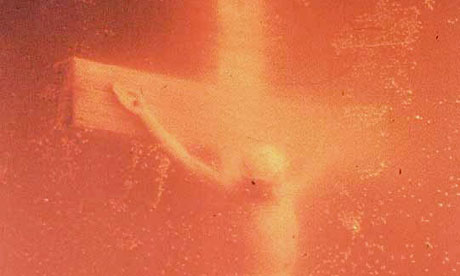
  • Piss Christ by Andres Serrano
    Andres Serrano's Piss Christ has been destroyed by Christian protesters in Avignon, France, after weeks of protests.

    When New York artist Andres Serrano plunged a plastic crucifix into a glass of his own urine and photographed it in 1987 under the title Piss Christ, he said he was making a statement on the misuse of religion.

    Controversy has followed the work ever since, but reached an unprecedented peak on Palm Sunday when it was attacked with hammers and destroyed after an "anti-blasphemy" campaign by French Catholic fundamentalists in the southern city of Avignon.

    The violent slashing of the picture, and another Serrano photograph of a meditating nun, has plunged secular France into soul-searching about Christian fundamentalism and Nicolas Sarkozy's use of religious populism in his bid for re-election next year.

    It also marks a return to an old standoff between Serrano and the religious right that dates back more than 20 years, to Reagan-era Republicanism in the US.

    The photograph, full title Immersion (Piss Christ), was made in 1987 as part of Serrano's series showing religious objects submerged in fluids such as blood and milk. In 1989, rightwing Christian senators' criticism of Piss Christ led to a heated US debate on public arts funding. Republican Jesse Helms told the senate Serrano was "not an artist. He's a jerk."

    Serrano defended his photograph as a criticism of the "billion-dollar Christ-for-profit industry" and a "condemnation of those who abuse the teachings of Christ for their own ignoble ends". It was vandalised in Australia, and neo-Nazis ransacked a Serrano show in Sweden in 2007.

    The photograph had been shown in France several times without incident. For four months, it has hung in the exhibition I Believe in Miracles, to mark 10 years of art-dealer Yvon Lambert's personal collection in his 18th-century mansion gallery in Avignon. The show is due to end next month, but two weeks ago a concerted protest campaign began.

    Civitas, a lobby group that says it aims to re-Christianize France, launched an online petition and mobilised other fundamentalist groups. The staunchly conservative archbishop of Vaucluse, Jean-Pierre Cattenoz, called Piss Christ "odious" and said he wanted this "trash" taken off the gallery walls. Last week the gallery complained of "extremist harassment" by fundamentalist Christian groups who wanted the work banned in France.

    Lambert, one of France's best known art dealers, complained he was being "persecuted" by extremists who had sent him tens of thousands of complaint emails and bombarded the museum with spam. He likened the atmosphere to "a return to the middle ages".

    On Saturday, around 1,000 Christian protesters marched through Avignon to the gallery. The protest group included a regional councillor for the extreme-right Front National, which recently scored well in the Vaucluse area in local elections. The gallery immediately stepped up security, putting plexiglass in front of the photograph and assigning two gallery guards to stand in front of it.

    But on Palm Sunday morning, four people in sunglasses aged between 18 and 25 entered the exhibition just after it opened at 11am. One took a hammer out of his sock and threatened the guards with it. A guard grabbed another man around the waist but within seconds the group managed to take a hammer to the plexiglass screen and slash the photograph with another sharp object, thought to be a screwdriver or ice-pick. They also smashed another work, which showed the hands of a meditating nun.

    The gallery director, Eric Mézil, said it would reopen with the destroyed works on show "so people can see what barbarians can do". He said there had been a kind of "inquisition" against the art work.

    In a statement, he said the movement against Piss Christ had started at the time of President Nicolas Sarkozy's ruling UMP party's controversial debate on religion and secularism in France. At a record low in the polls before next year's presidential election, Sarkozy has been accused of using anti-Muslim and extreme-right rhetoric to appeal to voters and counter the rise of the Front National.

    Asked by the daily Libération why the Piss Christ protest had happened now, Mézil pointed to Sarkozy's speech in March lauding "the Christian heritage of France" at Puy-en-Velay, where the first Crusades were preached.

    He said: "Clearly we saw in Saturday's demonstration that a Catholic fringe wanted to take the president at his word, with extremely violent appeals." He said there was a climate of tension, with protesters insulting museum staff of north African origin. One guard said he heard: "I'm going to pour donkey piss on the Qur'an." An email to the museum talked about "plunging the diary of Anne Frank in urine".

    The French culture minister, Frédéric Mitterrand, condemned the vandalism as an attack on the fundamental freedoms of creation and expression, but recognised that the art work could shock audiences.

    The secretary general of Civitas, Alan Escada, told Le Dauphiné Libéré paper: "I don't support or condemn what happened," adding that the attack on the picture "reflects an understandable exasperation" with the museum.

    A police complaint has been filed by the gallery and the guards.

    www.artfagcity.com/2011/04/25/the-false-promise-of-the-internet-feeds-the-resurrection-of-piss-christ/#comments